i agree, but that some of this stuff was so paint-by-the-numbers even with an uncommon premise is impressive.
- SuperJail Warden
- Gone Forever

- +699|4627
I paid $27.99 for Spiderman on Amazon Prime. I want to get the latest one for my students as a reward.
For one class I frankly had to turn it off since one autistic kid with an assistant objected to it since they said their mom didn't let them watch Spider-Man because his hand would do this.
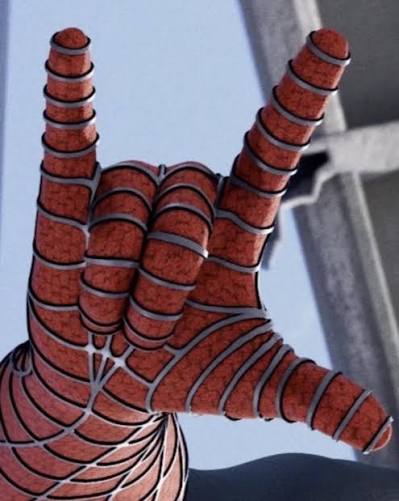
So no one got spiderman.
For one class I frankly had to turn it off since one autistic kid with an assistant objected to it since they said their mom didn't let them watch Spider-Man because his hand would do this.
So no one got spiderman.
is going to the library while the rest of the class watches a thing your parents don't want you to watch no longer an option? that's what jehovah's witnesses got to do while i was in school.
it's weird and/or funny that the mom is objecting to the spidey salute but not the gimp suit.
it's weird and/or funny that the mom is objecting to the spidey salute but not the gimp suit.
- SuperJail Warden
- Gone Forever
- +699|4627
The kid is so autistic he has an aide take him class to class and sit with him all day. Taking him to the library while the rest of the kids watch a movie is both discrimination and a change in routine that he would flip out about.
maybe the rest of the kids could go watch spiderman in the library while the kid and his aide stay in class.
- SuperJail Warden
- Gone Forever
- +699|4627
I would be a permission slip at that point.

Arachnophobia 7.5/10, invasive spider horror comedy which would have given me nightmares as a kid. Coulda been 15 minutes shorter. Jealous of all the characters who got a spider bite and died in 1 minute.


Idiocracy, I finally worked it out, its not a comedy, its a horror film.
#BoycottBurgerKing
i know we shouldn't compare that movie to rl as the memes go, but it's getting harder not to when the expert (as much as the protag qualifies) is tossed into a battle arena to appease the mob. what's wild into two terms of trump is that president camacho can admit when someone knows more about a thing than he does, and listen to advisors. he would be an upgrade.
https://www.theguardian.com/film/2026/o … and-talent
lol, lmao even.
lol, lmao even.
Lloyd Webber has vociferously criticised the film, saying Hooper did not consult those involved in the original West End show and saying “the whole thing was ridiculous”.
In 2021, he called it “off-the-scale all wrong” and said the experience left him so “emotionally damaged” he became a dog owner in an effort to recover.
lol, i'd forgotten about the butthole cut drama. easily the most entertaining part of that film was the humor found online.
people i know enjoyed cats '19. i've given my opinion when asked. you can be blind to the graphical mess, maybe there's a glimmer of hope. but i really don't get why you would put this on more than once when you have the '98 cats to watch instead.
dench puts it kindly. nobody set out to make a bad movie.
the creator of the cats musical being so traumatised by the film that he had to get an emotional support dog is just too funny, you couldn't even script it. high camp. brilliant.
Last edited by uziq (2026-10-20 22:20:31)
Well I thought it was OK, still waiting to hear someone give a rational explanation of what was 'wrong' with it which isn't just opinion and bile.
Cats was first performed 45 years ago, do people doing remakes generally 'consult' people from that long ago?
Cats was first performed 45 years ago, do people doing remakes generally 'consult' people from that long ago?
Last edited by Dilbert_X (2026-10-21 01:37:06)
#BoycottBurgerKing
the person who created the fucking musical hates it from the top down and you're still claiming its critics are irrational and full of bile? lmao. yeah man, i'm sure *checks notes* andrew lloyd-webber is irrationally biased against Cats.
and, yes, if you're making a remake or adaptation whose entire prospect is essentially a rollover of the success of the previous person's work, it's considered tactful and polite. authors of books are generally consulted on the movie or netflix adaptation - even if the producers do eventually fall out with them and get sick of humouring them on set.
judi dench is probably one of the most experienced and respected actors in the world working today. she said it was a stinker. wouldn't she know, having spent umpteen thousand hours of her life perusing scripts, being on set, doing press tours, etc.? i'm sure a person with over 60 feature films and 125+ acting credits on stage, radio, and tv has a pretty good sense of when a project went well and when it ... well, when it went Cats.
Last edited by uziq (2026-10-21 03:25:02)
What was actually wrong?Dilbert_X wrote:
still waiting to hear someone give a rational explanation of what was 'wrong' with it which isn't just opinion and bile.
The material?
The direction?
The acting?
The pacing?
The choreography?
The characterisations?
There's literally nothing anyone can point to as actually being wrong about it.
Last edited by Dilbert_X (2026-10-21 05:24:28)
#BoycottBurgerKing
the man who wasn’t there - 8/10.
holds up. one of the most overlooked movies in their filmography.
holds up. one of the most overlooked movies in their filmography.
been over this before, i'm pretty sure. (this) cats is a horse dead and buried, giblets roughly sewn together after many necropsies. we're grave robbing at this point.Dilbert_X wrote:
What was actually wrong?Dilbert_X wrote:
still waiting to hear someone give a rational explanation of what was 'wrong' with it which isn't just opinion and bile.
The material?
The direction?
The acting?
The pacing?
The choreography?
The characterisations?
There's literally nothing anyone can point to as actually being wrong about it.
here's an equal effort response, via slop:
The statement is partly right about the importance of giving specific, reasoned criticism, but substantially wrong in claiming that there is literally nothing professionally identifiable that was wrong with Cats (2019).
There are perfectly rational, technically grounded criticisms of the film. They concern precisely the things the statement lists: direction, pacing, choreography, characterisation and visual presentation. Professional critics made those arguments at the time, often in considerable detail.
The more interesting question is whether those criticisms were good criticisms, whether they explain the strength of the backlash, and whether the film's unusual artistic choices were being judged fairly.
## 1. What did professional critics actually say was wrong?
Seth Rogen Cats Review - Seth Rogen Got High and Tweeted a Recap of the Cats Movie
The visual effects and character design
The digital fur, human-cat anatomy and changes in the characters' apparent scale were widely criticised as visually distracting or uncanny. The characters occupied an awkward middle ground: neither convincingly feline nor comfortably recognisable as theatrical performers in cat costumes.
This is not merely a disagreement over whether cats should look realistic. It is a criticism of whether the visual design achieves its intended effect. The Guardian discussed the anatomical and tonal problems, while other reviews questioned the film's visual coherence.
The Guardian
+1
Who Is Francesca Hayward? The 'Cats' Star Is A Famous Ballet Dancer
The direction and cinematography
RogerEbert.com's review argued that director Tom Hooper repeatedly cut between angles, manipulated images and moved the camera around instead of allowing viewers to appreciate sustained dancing.
That's a concrete criticism of film technique: editing, shot duration, camera movement and the relationship between the camera and the performers. It is also a particularly strong counterexample to the claim that no one could identify anything wrong with the direction.
Roger Ebert
Cats trailer, cast, release date and more
The choreography and its presentation
The criticism was not necessarily that the dancers lacked ability or that the choreography contained no good ideas. Rather, the film often failed to showcase the dancers effectively.
The Guardian's dance and theatre critics praised the performers and identified the choreography's mix of ballet, Broadway and street-dance influences, while arguing that the dancers were too frequently relegated to the background or made to look unnatural through the use of wires and digital effects.
The Guardian
In other words, excellent choreography and poor cinematic presentation of that choreography can coexist.
Hear Jennifer Hudson's Thrilling Rendition of 'Memory' from Cats | Broadway Buzz | Broadway.com
The pacing and narrative structure
Cats inherits a fundamental challenge from the stage musical: its succession of character introductions and songs has relatively little conventional dramatic progression.
A film adaptation can preserve that episodic structure, but it still needs to sustain attention through visual development, rhythm, transitions and emotional investment. Several reviewers found the result repetitive, dull or dramatically inert. The Washington Post's review roundup identified the thin plot as one of the recurring objections.
The Washington Post
+1
The fact that the source material is episodic does not exempt its adaptation from criticism of its pacing.
Trailer zu "Cats": Idris Elba, Taylor Swift und Ian McKellen als singende Katzen - Kino News - FILMSTARTS.de
Characterisation, tone and acting choices
Critics also questioned the performances' tonal consistency, the sexualised presentation of the cat-humans, and whether the direction gave the characters meaningful emotional or comic identities.
The Observer review, for example, criticised the film's awkward combination of spectacle, sexuality and sentiment, and argued that the direction failed to give the material a convincing point of view.
The Guardian
+1
That is a judgement about how the performances, character designs, staging and direction work together—not simply a claim that the actors are untalented.
These are not five indisputable verdicts. Each can be challenged. But they are all identifiable critical arguments, supported by features of the finished film.
## 2. Is any of that objectively wrong, rather than just opinion?
This is where the statement makes its most interesting mistake: it seems to assume that if something is a matter of artistic judgement, it cannot be a rational criticism.
That is not how professional criticism works.
There are three different things to distinguish.
| Type of criticism | Example concerning Cats | How objective is it? |
| --- | --- | --- |
| Observable fact | The film uses extensive digital fur and digitally altered cat-like bodies. | Largely objective. |
| Technical assessment | Frequent cuts and camera movements interrupt the continuity of dance performances. | Testable against the film, though its artistic significance is debatable. |
| Aesthetic judgement | The cat designs are disturbing, the songs are tedious, or the film lacks magic. | Subjective, but can be supported by coherent reasoning. |
A critic cannot objectively prove that a film is ugly in the same way that they can prove its running time. But they can explain why its visual design might be distracting, inconsistent or counterproductive.
For example, the argument that Hooper's editing undermines the choreography is not simply "I don't like the editing." It proposes a relationship between a filmmaking decision and its effect on the audience. That relationship can be examined, debated and supported with examples.
Equally, another critic might argue that the unusual editing creates energy or that the unsettling character designs are appropriate to the film's surreal world. That is a legitimate counterargument.
Subjective does not mean irrational. And professional criticism does not require every conclusion to be objectively provable.
## 3. The strongest counterargument: some critics were wrong about what Cats was trying to do
The person making the statement is not entirely without a point.
The backlash against Cats was often unusually mocking, and some reviews concentrated on its strangeness rather than analysing its artistic intentions.
The most important counterexample is the Guardian's January 2020 assessment by dance and theatre critics Arifa Akbar and Lyndsey Winship. They challenged the prevailing negative reaction, arguing that some film critics seemed baffled by conventions that were already integral to the stage musical. They also praised elements of the film's performances, music and theatrical atmosphere.
The Guardian
That criticism of the critics deserves to be taken seriously.
Consider three possible objections to Cats:
- "The story makes no sense." This is a relatively weak criticism if it assumes that every musical must have a conventional, tightly plotted narrative. The original Cats is episodic by design.
- "The characters look ridiculous." This is not a complete argument unless the critic explains why the visual style fails. Unusual, grotesque or artificial imagery can be artistically effective.
- "The film is boring." This is a genuine report of a viewer's experience, but becomes more useful criticism when it identifies repetition, weak dramatic progression, poor rhythm or a failure to sustain attention.
In other words, critics can misunderstand a work's intentions. A film does not become bad merely because it violates conventional expectations.
But there is an important distinction: understanding what a film is trying to do does not oblige you to conclude that it succeeds.
The stage musical's surrealism might be intentional, yet its film adaptation might still handle that surrealism poorly. The problem is not necessarily the strangeness; it may be the way the strangeness is presented.
## 4. What about the acting, pacing and choreography specifically?
These categories are worth examining separately because the statement implies that, unless someone can identify a simple, demonstrable error, there is nothing wrong with the film.
### Acting
The cast includes experienced actors, accomplished singers and highly skilled dancers. That is not in dispute.
But casting talented people does not guarantee effective performances. Acting for a musical film involves choices about physicality, facial expression, vocal delivery, tone and the relationship between performance and camera.
A performance can be technically competent but poorly directed, excessively mannered or tonally incompatible with its surroundings.
Conversely, the film has defenders who appreciate particular performances. Sheila O'Malley's review for RogerEbert.com, for example, praises Jennifer Hudson's interpretation of Grizabella and her rendition of "Memory", despite criticising the film's approach to filming dance.
Roger Ebert
That is a good illustration of how criticism can be discriminating rather than simply dismissive.
### Pacing
The film's episodic structure is inherited from the musical, but the adaptation still has to determine how long each number lasts, how it transitions between characters and how it maintains momentum.
The Observer's Simran Hans criticised the film's thin narrative framework and the way it attempted to generate emotional impact without sufficient dramatic development.
The Guardian
One can reasonably disagree with that assessment, but it is a recognisable argument about dramatic structure, not mere bile.
### Choreography
This is arguably where the statement has the least force.
There are highly accomplished dancers in Cats, and the film contains moments of impressive movement. It would be unfair to dismiss the entire choreography simply because the finished film has problems.
Yet choreography and its cinematic presentation are separate things. A dance can be beautifully conceived and performed but badly served by editing, framing, visual effects or camera placement.
The Guardian's dance critics made precisely this distinction: they recognised the quality of the dancers while arguing that the film did not give their work sufficient room to shine.
The Guardian
That is not an argument that the choreography itself is bad. It is an argument that the filmmaking fails to do justice to it.
## 5. Does the critical consensus prove that Cats was bad?
No. But it is evidence worth considering.
The film's critical reception was overwhelmingly negative. Rotten Tomatoes records a 19% critics' score based on 336 reviews in the result retrieved for this assessment.
Rotten Tomatoes
That does not prove the film is objectively bad. Review aggregators measure the balance of favourable and unfavourable reviews, not an independently verified quantity called artistic quality.
Nor does consensus mean every critic arrived at their conclusion independently, without influence from the prevailing conversation. The extraordinary reaction to the trailer, the film's unconventional appearance and the increasingly mocking public discourse could all have influenced how people approached the finished film.
But the opposite claim—that the consensus was nothing but bile—is equally unsupported. Several critics offered detailed, technically specific arguments about editing, visual effects, dramatic structure and the failure to exploit the performers' abilities.
The existence of a critical consensus is not proof of correctness. The existence of a backlash is not proof of a conspiracy or a collective failure of judgement.
## 6. My overall verdict on the bracketed statement
What it gets right
Critics should explain their reasoning rather than substitute ridicule for analysis. Cats has genuine artistic ambitions and talented performers, and some of the reaction to its unconventional imagery was arguably superficial. There are also defensible reasons to enjoy the film.
What it gets wrong
It falsely equates the absence of objectively provable artistic defects with the absence of rational criticism. It also overlooks the substantial professional criticism of the direction, editing, visual effects, narrative structure and cinematic presentation of the choreography.
What a fair conclusion looks like
Cats is a highly unconventional adaptation whose artistic merits are open to debate. Some criticisms are stronger than others, and some of the mockery obscured legitimate analysis. But the film's defenders need to address the substantive criticisms rather than claim that none exist.
### The fundamental flaw in the argument
The most revealing sentence is:
> There's literally nothing anyone can point to as actually being wrong about it.
That is an extraordinarily strong claim, and it is easily disproved by the existence of specific, reasoned criticism.
The claim would be more defensible if it said that there is nothing demonstrably, objectively wrong with the film in the sense of a technical error or a violation of some universal rule of filmmaking. Even then, that would not establish that its artistic decisions are successful.
A film can contain no obvious technical mistakes and still fail aesthetically. It can also contain unconventional or even deliberately awkward choices that some viewers find artistically rewarding.
Ultimately, the useful question is not whether Cats is objectively wrong. It is whether the choices its filmmakers made produce the effects they intended, whether those effects are artistically worthwhile, and whether the finished film succeeds on its own terms.
Those are precisely the questions professional criticism is supposed to investigate.
My conclusion: the bracketed statement is a reasonable defence against lazy, sneering criticism, but a poor defence of the film against serious criticism. It demands rational explanations from detractors while dismissing the possibility that such explanations exist. The professional reviews show that they do.
it's a hot mess.Here’s a shortlist of the sources referred to in my earlier answer, with direct links and a brief note on what each contributes.
## Key sources on Cats (2019)
1. [The Guardian — “Cats review – a purr-fectly dreadful hairball of woe”](<https://www.theguardian.com/film/2019/dec/19/cats-review-tom-hooper-judi-dench-idris-elba-taylor-swift?utm_source=chatgpt.com>) Peter Bradshaw's review. Focuses on the visual design, digital fur, characterisation and acting. It's a useful example of a strongly negative review, though its deliberately humorous style is not always technical analysis.
2. [The Observer / The Guardian — “Cats review – will haunt viewers for generations”](<https://www.theguardian.com/film/2019/dec/21/cats-review-tom-hooper-taylor-swift-judi-dench-idris-elba-jennifer-hudson-ian-mckellen?utm_source=chatgpt.com>) Simran Hans's review. Particularly relevant to the criticisms of choreography, pacing, digital effects, scale and the film's failure to convey emotion through its dance sequences.
3. [RogerEbert.com — Cats movie review](<https://www.rogerebert.com/reviews/cats-movie-review-2019?utm_source=chatgpt.com>) Sheila O'Malley's review. Useful for a more discriminating assessment of the film, including praise for Jennifer Hudson's performance alongside criticism of how the film presents its performers.
4. [The Washington Post — “A roundup of the most memorable ‘Cats’ reviews”](<https://www.washingtonpost.com/arts-entertainment/2019/12/20/biggest-disaster-decade-roundup-most-memorable-cats-reviews/?utm_source=chatgpt.com>) A collection of contemporary reviews from different publications. Particularly useful for comparing objections to the CGI, thin plot, editing and tone, and for seeing how technical criticism sometimes became outright mockery.
5. [The Guardian — “‘A furry orgy in a dumpster’: what the reviews say about Cats”](<https://www.theguardian.com/film/2019/dec/19/a-furry-orgy-in-a-dumpster-what-the-reviews-say-about-cats?utm_source=chatgpt.com>) Another roundup of reviews, with examples of both ridicule and more considered criticism. Helpful for evaluating whether the backlash was based on specific artistic objections or simply the film's unusual appearance.
## The most useful pair to read first
I'd start with the RogerEbert.com review and the Observer review. Together, they illustrate the distinction at the heart of your question: a critic can acknowledge talented performers and worthwhile elements while still arguing that the direction, editing or visual presentation undermines the finished film.
The Washington Post roundup is the best next stop if you want to compare a wider range of professional opinions rather than rely on any single critic.
Last edited by unnamednewbie13 (2026-10-21 17:08:48)
have you just considered, dilbert, that your taste is pretty defective? you have a predilection for sentimental youtube covers and utter mush. that's not a moral judgment: just that you consume things almost solely for their immediate emotional appeal to you, with little discernment or care for technique, accomplishment, or critical quality.
declaring just criticism "irrational" because it disagrees with your fEelIngZ about a particular movie or intellectual property is not how you do art discussion.
your taste is bad. s'ok.
declaring just criticism "irrational" because it disagrees with your fEelIngZ about a particular movie or intellectual property is not how you do art discussion.
your taste is bad. s'ok.